Oxide balance
Oxides from ingredient masses, R₂O and RO totals, melting loss and SO₃ budget, with a live preview while editing.
Batch calculation · W-Make Recipe
Glass batch calculation converts the target oxide composition into raw material weights, using the analyses of the raw materials. Loss on ignition, moisture and cullet all have to be included. W-Make Recipe does this calculation and keeps every recipe version.
As you change the weights, the preview recalculates cost, redox, working point and oxide balance. The result goes out as print, PDF or Excel.
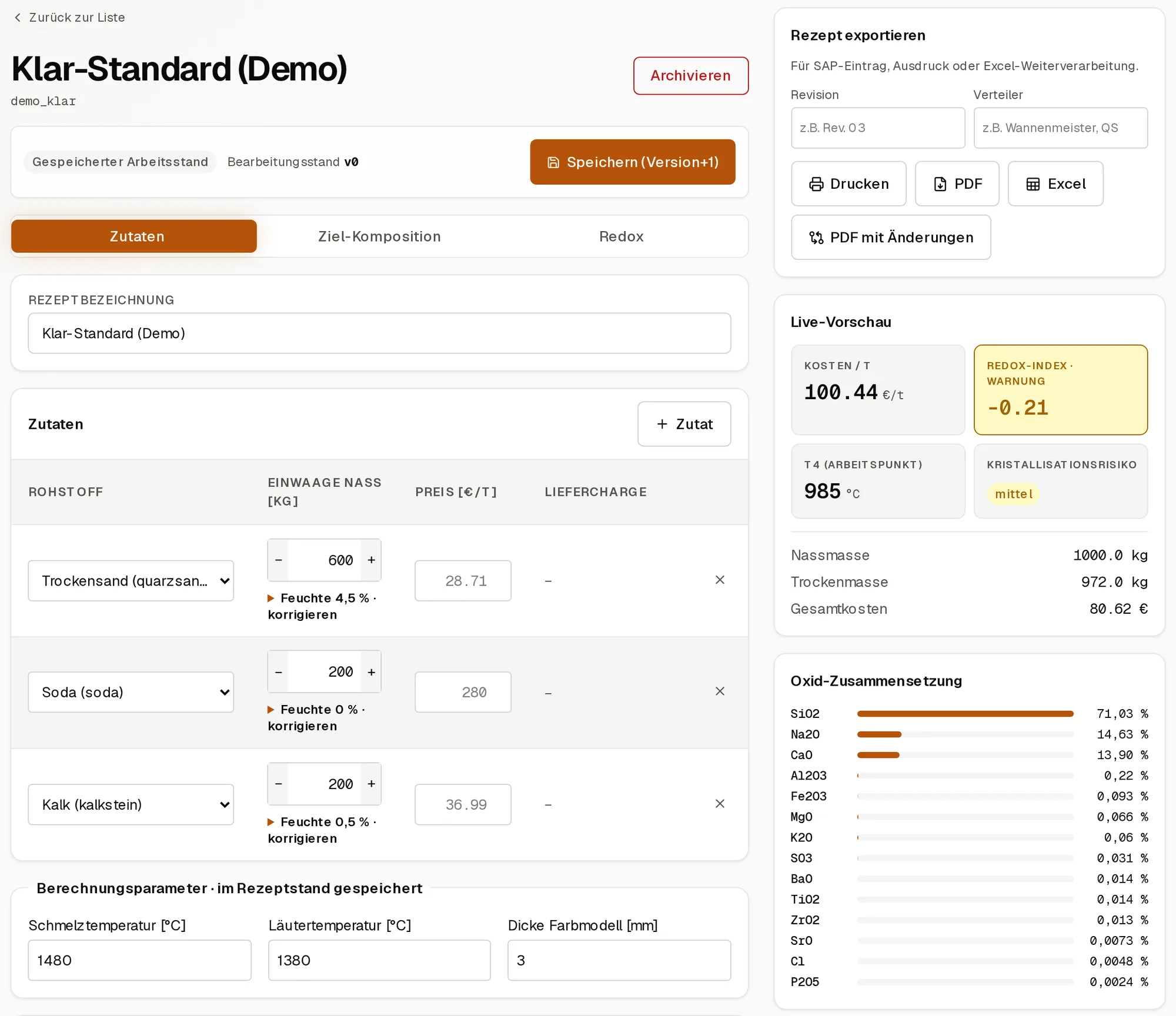
You enter the oxide target profile and select the available raw materials. The solver proposes matching quantities. Limits can be set per oxide and raw material.
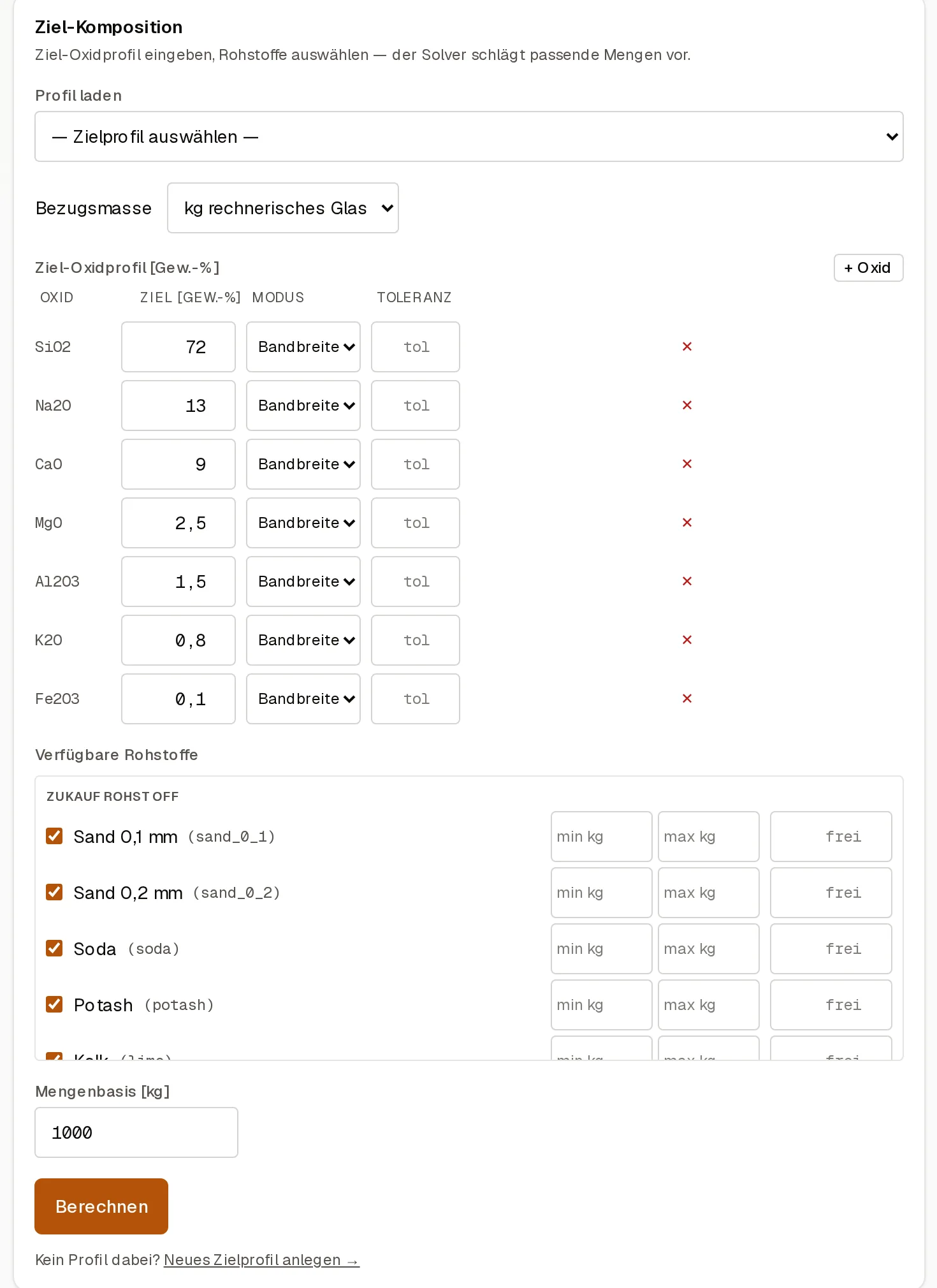
Working point, transition temperature, liquidus, viscosity points, density and durability sit next to the recipe. Estimates are labelled as such.
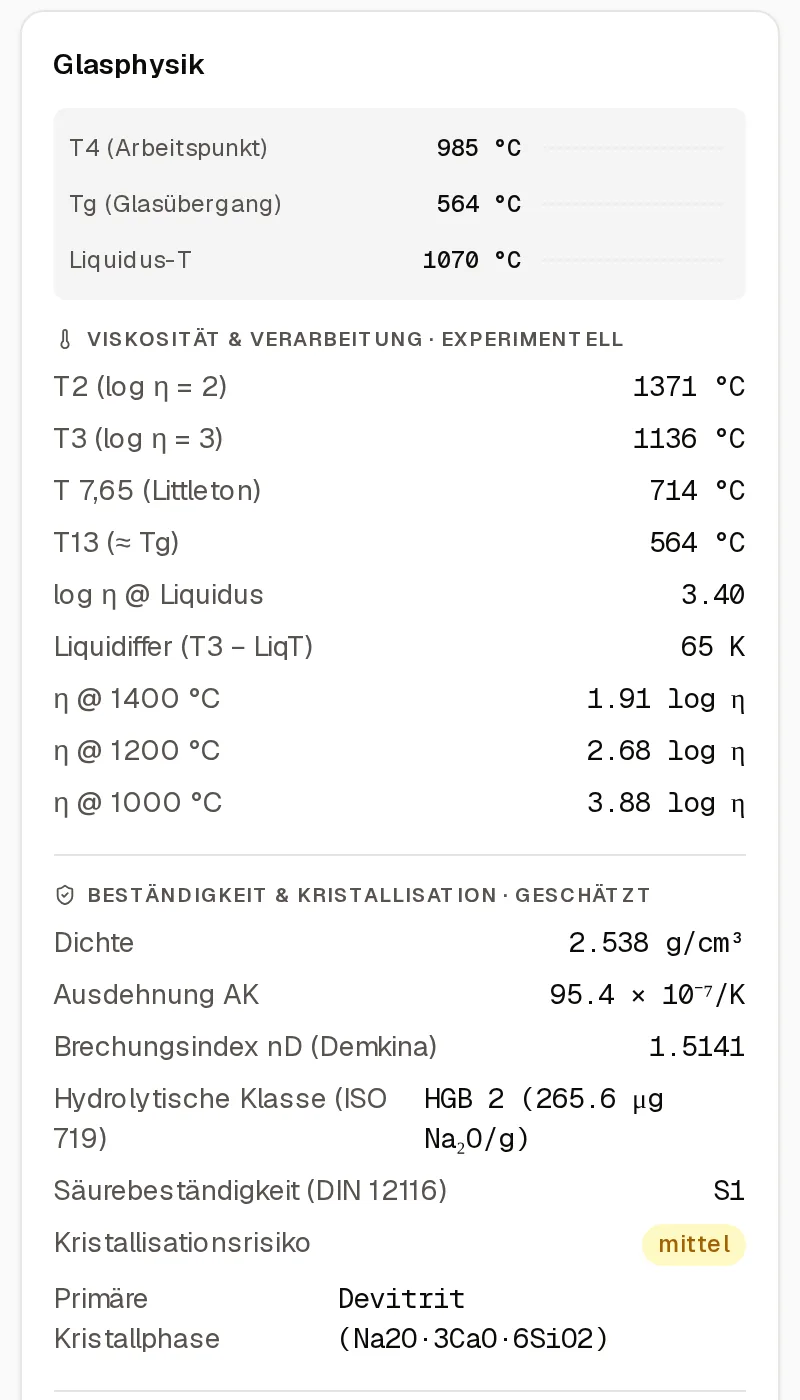
A separate area shows the calculated redox state, the colour forecast, the redox-temperature curve and the fining window. Each model is named.
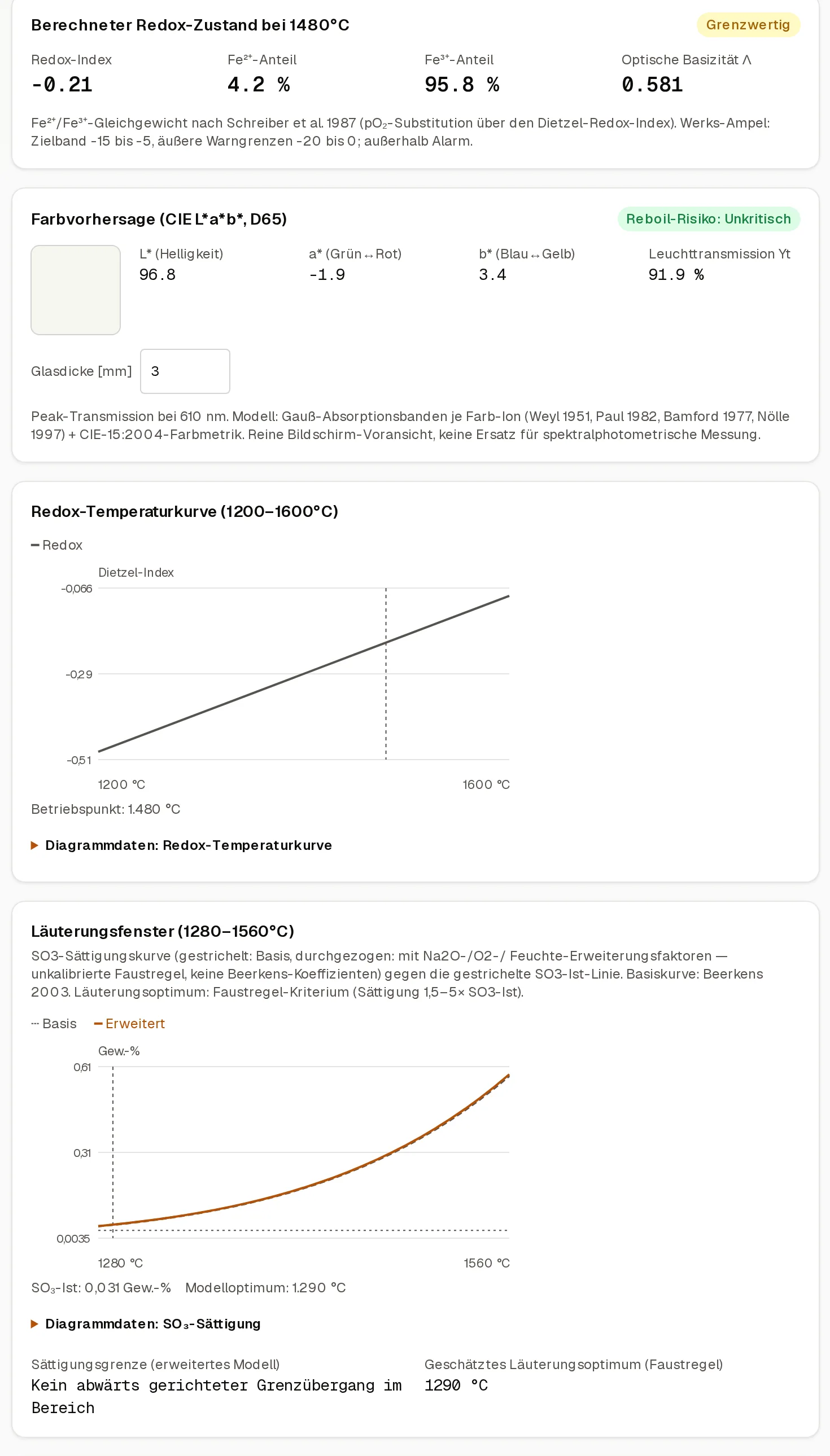
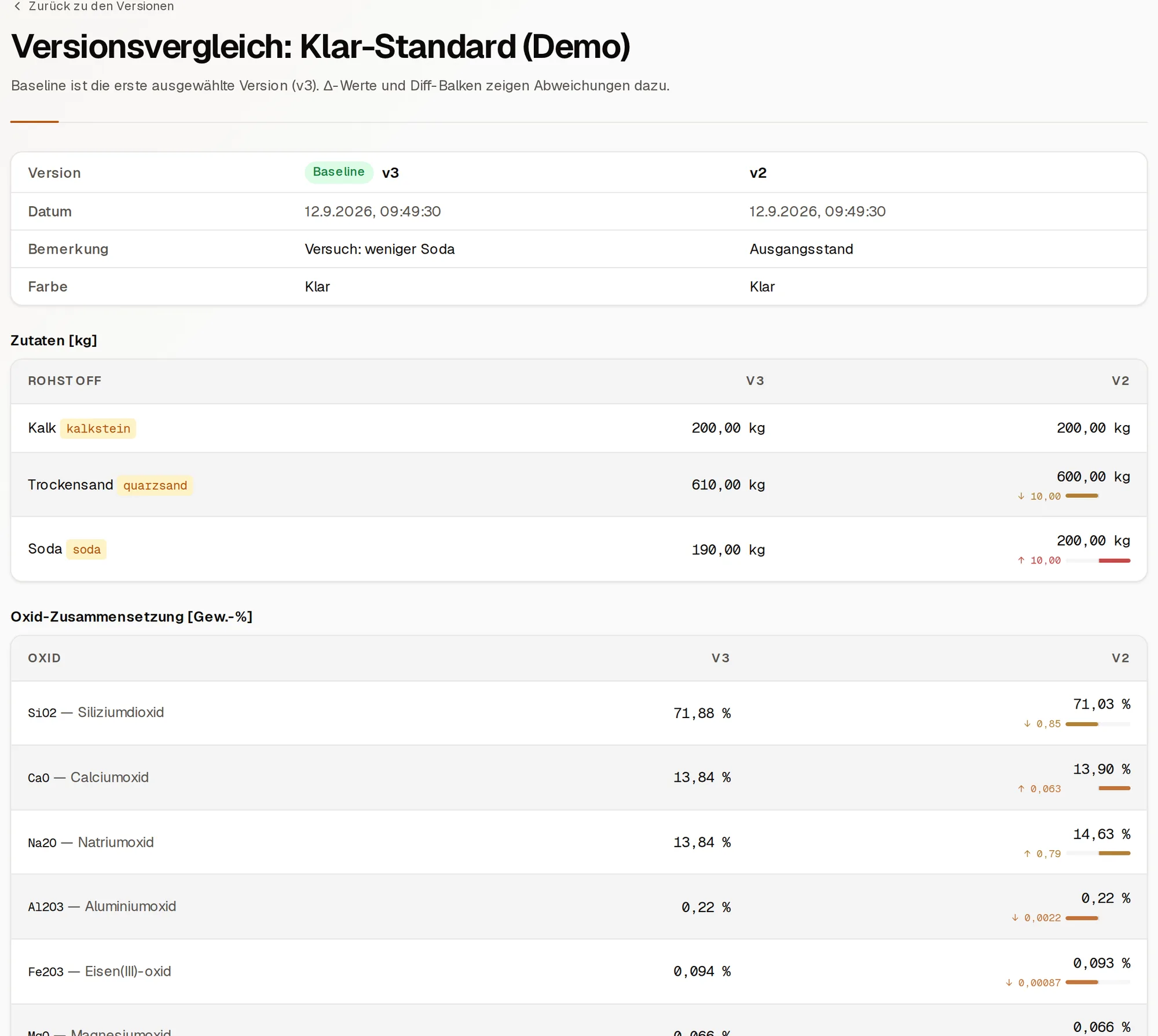
Every save creates a version. The comparison sets weights, oxides and physics side by side and marks the differences.
The starting point is the composition of the glass in oxides, for example SiO₂, Na₂O and CaO. Each oxide has to come from a raw material. Soda ash supplies Na₂O, limestone supplies CaO, and both release CO₂ during melting. That is why the batch weighs more than the glass it produces. This loss of mass is called loss on ignition.
We need the weights for 72 kg SiO₂, 13 kg Na₂O and 11 kg CaO, so 96 kg of oxides. The raw materials are assumed to be pure and dry here.
| Raw material | supplies | Oxide share in raw material | Weight |
|---|---|---|---|
| Silica sand (SiO₂) | 72 kg SiO₂ | 100% | 72.0 kg |
| Soda ash (Na₂CO₃) | 13 kg Na₂O | 58.5% | 22.2 kg |
| Limestone (CaCO₃) | 11 kg CaO | 56.0% | 19.6 kg |
| Total | 96 kg oxides | 113.9 kg |
113.9 kg of batch yields 96 kg of glass. The remaining 17.9 kg escapes as CO₂.
Real raw materials supply several oxides. Dolomite brings CaO and MgO, feldspar Al₂O₃ and alkalis. Change one quantity and the balance shifts in several places.
Each delivery can be composed slightly differently. The calculation is only as good as the analysis behind it.
At the scale, weight includes moisture. The glass calculation uses dry mass.
Cullet brings its own oxides and has hardly any loss on ignition. A high cullet share therefore changes the weights of all other raw materials.
Oxides from ingredient masses, R₂O and RO totals, melting loss and SO₃ budget, with a live preview while editing.
From an oxide target profile and the available raw materials, a solver (NNLS) proposes the quantities. Tolerances can be set per oxide.
T2, T4, Tg and liquidus after Lakatos, a Vogel-Fulcher-Tammann viscosity curve and a comparison curve after Fluegel.
Redox after Dietzel, hydrolytic class after Vogel, acid resistance to DIN 12116, and a plausibility check against a container-glass target profile.
Every save creates a version. Several versions can be compared side by side for ingredients, oxides and physics.
Print, PDF and Excel, with an oxide table comparing actual and target. Deviations above 1% are marked in red.
Calculated properties are model values from published regressions. They help compare recipes but do not replace a lab analysis or a trial at the furnace. W-Make Recipe is geared to container glass.
You set the target oxide composition and divide each oxide quantity by that oxide's share in the raw material. That gives the weight. With raw materials supplying several oxides, this becomes a system of equations that software solves faster and more reliably.
Loss on ignition is the share of mass that escapes as gas during melting, mainly CO₂ from soda ash, limestone and dolomite. That is why the batch weighs more than the glass it produces.
Cullet is calculated like a raw material with its own oxide analysis. In W-Make Recipe it forms its own raw material group alongside purchased and in-house material.
Yes. You set the oxide target profile and the available raw materials, and the solver proposes the quantities. You can then adjust the result by hand and save it as a version.
First call · 30 minutes · free
A few sentences about the process are enough: what runs in lists or side calculations today, and who works with it. Within two working days you get a reply and a clear view of whether I am the right person for it.